
COMPUTER SCIENCE & INFORMATION TECHNOLOGY REFEREED SCHOLARLY JOURNAL

Advancing Computing Systems & Information Science

An international, refereed, double-blind peer-reviewed open access journal dedicated to publishing high-impact empirical investigations, novel system architectures, and theoretical foundations in Information Technology and Information Science.

7.9
Impact Factor
100%
Open Access
< 25%
Similarity Limit
2,500 INR
Article APC
OFFICIAL PUBLICATION VOLUME // 2026 OPEN ACCESS CC-BY 4.0
NRJITIS Computing Systems & Neural Hardware Artwork
COMP_SYS_ARCH Vol. 13 (2026)
NATIONAL PRESS ASSOCIATES
Official ISSN 2350-1278

National Research Journal of Information Technology & Information Science

Vol. 13 (2026) 59 Manuscripts IF: 7.9
ISSN (Print & Online) 2350-1278
Review Protocol Double-Blind Peer Review
Frequency Biannual (2 Issues / Year)
Access Model Open Access (CC-BY 4.0)
Publisher National Press Associates
// NPA_JOURNAL_PUBLISHING_NETWORK

Explore Other 11 Scholarly Journals Published by National Press Associates

Finance & Banking ISSN: 2349-6762

National Research Journal of Banking and Finance Management

Banking Systems, Capital Markets, FinTech & Corporate Finance

Human Resource ISSN: 2394-059X

National Research Journal of Human Resource Management

Organizational Behavior, Talent Strategy, HR Analytics & Labor Relations

Business Economics ISSN: 2349-2015

National Research Journal of Business Economics

Macro/Microeconomics, International Trade, Industrial Policy & Management

Biotechnology ISSN: 2321-8681

Research & Reviews in Biotechnology & Biosciences

Genomics, Bioinformatics, Molecular Biology, Agricultural & Medical Biotech

Education & Psych ISSN: 2249-040X

Academe Journal of Education & Psychology

Pedagogy, Digital Learning, Cognitive Psychology & Child Development

Literature & Arts ISSN: 2347-8705

Journal Literary Aesthetics

Literary Theory, Comparative Literature, Cultural Studies & Linguistics

Sales & Marketing ISSN: 2349-512X

National Research Journal of Sales & Marketing Management

Digital Marketing, Consumer Analytics, Brand Strategy & Retail Logistics

Social Sciences ISSN: 2348-473X

National Research Journal of Social Sciences

Sociology, Political Science, Anthropology, Governance & Public Administration

Multidisciplinary ISSN: 0976-5301

COHERENCE: Multidisciplinary Research Journal

Cross-Disciplinary Applied Sciences, Technology Convergence & Social Innovation

COHERENCE Visit Journal
Management ISSN: 2349-4883

Nehru School of Management Journal

Strategic Leadership, Operational Research, Entrepreneurship & Supply Chain

Development Studies ISSN: 2455-0760

SUTLEJ – Journal of Literature, Sciences & Development Studies

Regional Development, Environmental Ecology, Heritage & Applied Sciences

Computing & Informatics Mandate

[PEER_REVIEWED_OPEN_ACCESS]
NRJITIS Computing Systems & Information Architecture
RESEARCH MANDATE • ISSN: 2350-1278

Advancing Informatics, Algorithmic Foundations & Cyber Systems

Computer Systems

Distributed engines, parallel systems & hardware-software co-design.

Artificial Intelligence

Machine learning, transformers, neural models & computer vision.

Information Science

Zero-trust security, cryptography, analytics & data governance.

The National Research Journal of Information Technology and Information Science (NRJITIS) (ISSN: 2350-1278) is an international, refereed, double-blind peer-reviewed open access academic publication dedicated to advancing scholarship, innovative methodologies, and foundational computing discoveries.

Published biannually by National Press Associates, the journal serves as a collaborative platform for scholars, systems architects, and informatics researchers worldwide to share original research, emerging technologies, and robust empirical evaluations across Data Science, Cybersecurity, Artificial Intelligence, Software Engineering, Distributed Systems, and Digital Informatics.

Journal Specifications & Governance

ISSN (Print & Online) 2350-1278
Impact Factor 7.9 (Refereed)
Peer Review Model Double-Blind
Accessibility CC-BY 4.0 Open Access
Frequency Biannual (2 Issues/Yr)
Article Processing Fee 2500 INR (Online+Print)
Plagiarism Policy Turnitin < 25% Allowed
AI Content Policy Declared < 10% Allowed
Language of Publication English
Publisher National Press Associates

Scope of Accepted Manuscripts

The journal invites submission of high-caliber manuscripts meeting criteria of scientific excellence across 4 key formats:

Original Research Articles

Novel algorithmic architectures, empirical experiments & theoretical proofs.

Comprehensive Surveys

State-of-the-art literature syntheses, benchmarkings & emerging trend mappings.

Conference Proceedings

Select peer-reviewed symposium proceedings & high-impact short communications.

Book Reviews & Monographies

Critical scholarly reviews of authoritative textbooks & technical treatises.
Important Ethical Notice for Authors

Authors are requested to submit only original research papers and articles that are strictly free from plagiarism and comply with the journal's originality requirements. Adherence to ethical guidelines includes mandatory declaration of any AI-assisted drafting (maximum 10% allowed threshold). Authors remain solely responsible for ensuring the authenticity, methodological reproducibility, and ethical integrity of their manuscripts before final submission.

Rigorous 4-Step Peer-Review & Publication Protocol

From submission to global open-access dissemination, every computing manuscript undergoes a transparent, double-blind evaluation cycle.

STEP 01

Manuscript Submission & Desk Check

Initial editorial desk screening for domain relevance, author guidelines adherence, and automated Turnitin plagiarism check (< 25%).

STEP 02

Double-Blind Peer Review

Submissions are assigned to 2-3 independent domain specialists with author and reviewer identities strictly masked to eliminate bias.

STEP 03

Editorial Decision & Revisions

Comprehensive referee feedback is synthesized within 2 to 3 weeks; authors address comments for final editorial board ratification.

STEP 04

Publication & Dissemination

Typeset manuscripts receive immediate open-access publication under CC-BY 4.0, volume assignment, DOI indexing, and author certificates.

// AUTHOR_CREDENTIAL_AUTHENTICATION

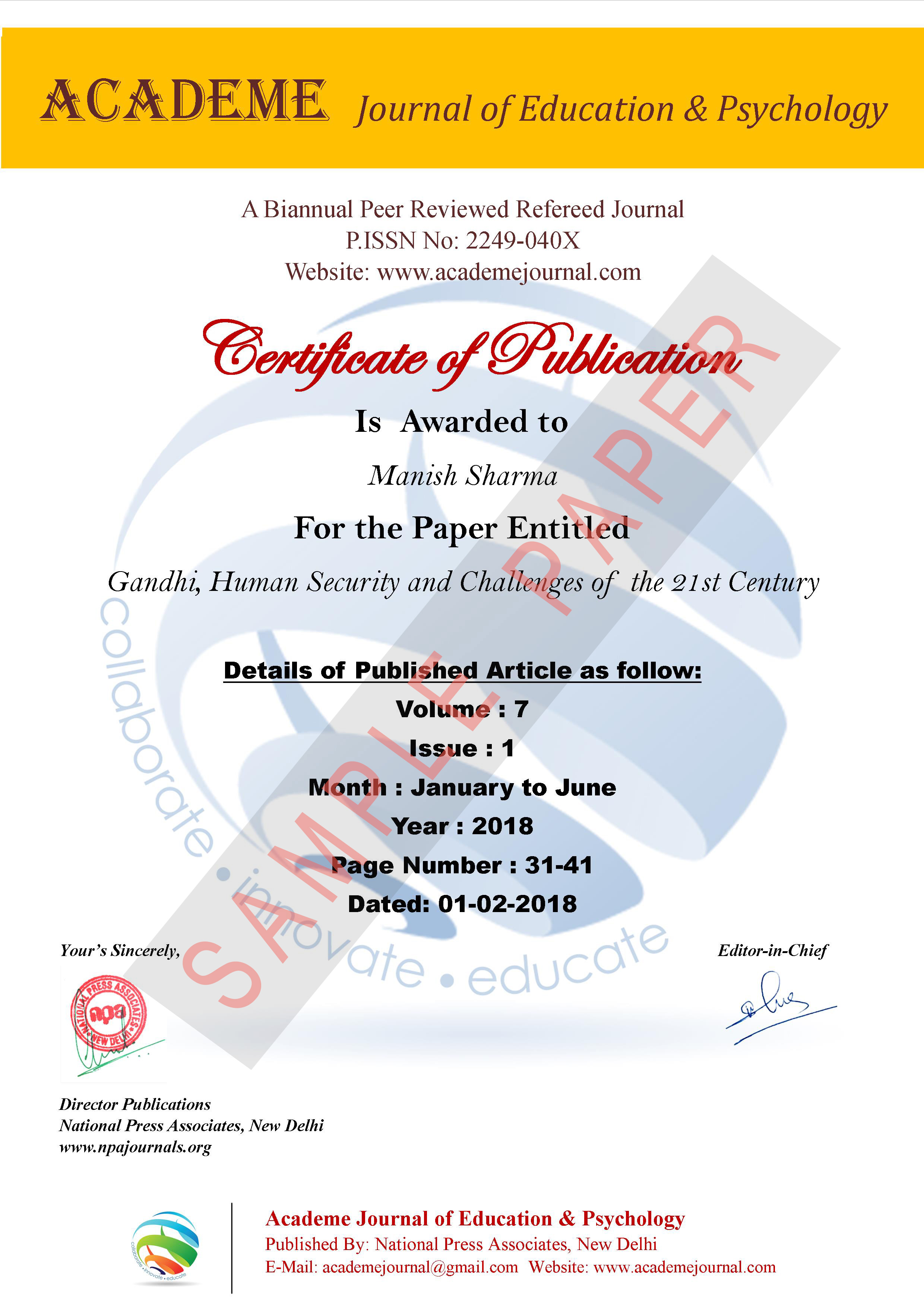
Official Digitally Signed Publication Certificate

Upon successful peer review and publication, every corresponding and contributing author receives an official, high-resolution Certificate of Publication. Each certificate carries the registered manuscript title, author names, volume identification, ISSN verification, and the authenticated editorial seal.

Tamper-Proof Digital Seal ISSN: 2350-1278 Verified Instant PDF Download Refereed & Peer-Reviewed
Official Certificate of Publication Sample
ISO 9001:2015 ACCREDITED SEAL
// ACTIVE_REGULAR_ISSUE

Current Issue: Volume-13, Issue-1 (January-June) (2026)

59 Manuscripts Published View Past Archives
[AI & Deep Learning] • Research Paper • DOI: https://doi.org/10.5281/zenodo.18654442 • Open Access (CC-BY 4.0)
Vol. 13 (2026) • pp. 1-22

AWARENESS AND USE OF HEALTH INFORMATION RESOURCES BY FEMALE STAFF IN UNIVERSITIES OF PUNJAB AND CHANDIGARH

Abstract

The health of the population constitutes the foremost asset of any state. Essential needs such as healthcare, adequate nutrition and education are as vital as fundamental rights in a democratic country like India. However, despite decades of independence, India’s healthcare system has progressed at a relatively slow pace. This sluggish development can be attributed to several factors, including insufficient investment in the health sector, widespread illiteracy, weak economic conditions, and limited public awareness regarding the significance of good health as well as existing government health schemes and services. Rapid population growth, lack of safe drinking water, environmental pollution, poor sanitation, and unbalanced dietary practices further contribute to the country’s health challenges. Another major reason for poor health outcomes is the underdeveloped public health infrastructure. Although both central and state governments have launched numerous health programs and schemes over time, many have failed due to inadequate implementation, weak planning, low public awareness, and the absence of effective grievance redressal mechanisms. Additionally, insufficient access to reliable health information and limited awareness of appropriate health information resources remain critical issues.

[AI & Deep Learning] • Research Paper • DOI: https://doi.org/10.5281/zenodo.18654463 • Open Access (CC-BY 4.0)
Vol. 13 (2026) • pp. 23-29

INTEGRATION OF ARTIFICIAL INTELLIGENCE AND DATA SCIENCE: A SYSTEMATIC APPROACH

Abstract

ABSTRACT
Artificial Intelligence (AI) and Data Science (DS) have come together as a single paradigm for intelligent, data-driven decision making as a result of the quick development of computer technology. While data science concentrates on data collection, processing, statistical analysis, and knowledge extraction, artificial intelligence offers algorithms with learning,
reasoning, and automation capabilities. Research and industrial practices in the fields of healthcare, finance, environmental sciences, smart cities, and education have all changed as a result of the integration of these two domains. This review paper offers a methodical, researcher-focused examination of the combination of data science and artificial intelligence.
Conceptual underpinnings, methodological frameworks, tools and technologies, important application fields, difficulties, ethical issues, and future research prospects are all covered. The purpose of the publication is to provide researchers, academics, and practitioners working in the nexus of AI and data science with a thorough reference.

Keywords: Artificial Intelligence, Data Science, Machine Learning, Big Data Analytics, Deep Learning, Intelligent Systems

[AI & Deep Learning] • Research Paper • DOI: https://doi.org/10.5281/zenodo.18654496 • Open Access (CC-BY 4.0)
Vol. 13 (2026) • pp. 30-39

MACHINE LEARNING AND DEEP AUTOENCODERS FOR ZERO-DAY CYBER-ATTACK DETECTION: A REVIEW

Abstract

ABSTRACT
The high rate of Internet of Things (IoT) technologies and networks development has greatly exposed businesses to advanced cyber-attacks, especially zero-day attacks that use the vulnerabilities that were unfamiliar before. Because they rely on established patterns, standard signature-based intrusion detection systems (IDS) are unable to identify such attacks. This paper presents a strong deep learning-based intrusion detection model which uses the autoencoder designs to detect network behavior that is abnormal. The model can effectively detect deviation of normal traffic that can be viewed as a symptom of a zero-day attacks by learning representations of normal traffic, but the model keeps the false-negative
rates at a minimum. Evaluation of the suggested approach is performed with the help of benchmark datasets, i.e. NSL-KDD, CICIDS2017, and IoT-based traffic gathering and contrasted with conventional machine learning techniques like One-Class Support Vector Machines. The results of the experiment prove that the models using autoencoders have better
detection accuracy, recall and F1-scores, especially in complicated and low-volume attack conditions. The results confirm that deep autoencoders are an appropriate choice in scalable, adaptive, and high-performance zero-day intrusion detection in contemporary IoT and cyberphysical network settings.

Keywords: Zero-Day attacks; Intrusion Detection Systems (IDS); Deep learning; Autoencoders; Anomaly Detection; machine learning.

[AI & Deep Learning] • Research Paper • DOI: https://doi.org/10.5281/zenodo.18654509 • Open Access (CC-BY 4.0)
Vol. 13 (2026) • pp. 40-49

ALGORITHMIC MANAGEMENT AND AI IN HUMAN RESOURCE PRACTICES: OPPORTUNITIES, CHALLENGES, AND IMPLICATIONS

Abstract

ABSTRACT
The inclusion of Artificial Intelligence (AI) and algorithmic management in human resources (HR) has restructured new workforce dynamics and organisation design, transforming how work is organised and performed in the digital age. Drawing on these theoretical perspectives, the present study examines the multi-dimensional impact of AI on HR, focusing on recruitment and selection, performance appraisal, workplace monitoring, employee
engagement, and well-being. Utilising sociotechnical systems theory and synthesising over 50 recent references and empirical research articles, the paper offers an integrated and critical discussion of the implications and ethical issues of the rise of algorithmic HR systems. It discusses how AI-powered solutions can improve decision quality, streamline administrative
tasks and support data-driven talent management decisions. At the same time, it draws attention to concerns such as algorithmic bias, opaque decision-making processes, psychological contract breaches, and the risk of eroding the trust and autonomy of workers. Applying an integrated conceptual lens, which draws on the augmentation-automation paradox, machine learning fairness, and algorithmic transparency principles, we map out routes towards a more inclusive, equitable, and ethically responsible use of AI in HRM. This work has implications for managers, policymakers, and technology developers who seek to reconcile efficiency with human-centric values in the era of innovative technologies.

Keywords: Artificial Intelligence, Algorithmic Management, Human Resource Management, Ethical Implications, Workforce Transformation

[AI & Deep Learning] • Research Paper • DOI: https://doi.org/10.5281/zenodo.18654530 • Open Access (CC-BY 4.0)
Vol. 13 (2026) • pp. 50-61

TRIGONOMETRY ACROSS MATHEMATICS AND COMPUTATION: CLASSICAL CONSTRUCTIONS, ANALYTIC EXTENSIONS, AND APPLIED HARMONIC METHODS

Abstract

ABSTRACT
Trigonometry is the mathematical study of relationships between angles and lengths, originally motivated by problems in astronomy, surveying, and geometry. Over time it evolved into a central language of periodicity and rotation, deeply embedded in calculus, linear algebra, complex analysis, signal processing, physics, and modern computing. This article presents a
detailed research-style exposition of trigonometry, beginning with classical Euclidean definitions and moving through identities, inverse functions, laws of triangles, and analytic formulations. It then develops the deeper structural view of trigonometric functions as coordinate projections on the unit circle, as solutions to differential equations, and as manifestations of complex exponentials. Finally, it surveys major applications including waves,
Fourier analysis, navigation, robotics, and imaging, while highlighting contemporary computational perspectives.

Keywords: Trigonometry, Unit Circle, Angle Measurement, Trigonometric Identities, Inverse Trigonometric Functions, Laws of Sines and Cosines, Complex Exponentials, Euler’s Formula, Differential Equations, Harmonic Motion, Waves and Oscillations, Fourier Series.

Information Technology & Information Science Scope

NRJITIS accepts novel empirical research, computational architectures, and systematic literature surveys across six foundational computing disciplines.

Artificial Intelligence & Deep Learning

Neural architectures, transformers, large language models, computer vision, reinforcement learning, automated reasoning, and cognitive computing.

#DeepLearning #Transformers #LLMs #ComputerVision

Cybersecurity & Information Assurance

Zero-trust architectures, applied cryptography, post-quantum crypto, blockchain distributed ledgers, intrusion detection, and digital forensics.

#ZeroTrust #PostQuantum #Blockchain #DigitalForensics

Big Data & Knowledge Engineering

High-dimensional data analytics, real-time stream processing, distributed databases, semantic web schemas, and large-scale knowledge graphs.

#DistributedData #StreamProcessing #SemanticWeb #KnowledgeGraphs

Cloud, Edge & Distributed Systems

Serverless computing, container orchestration, microservice fault tolerance, IoT sensor telemetry, edge intelligence, and ubiquitous networks.

#Serverless #Kubernetes #EdgeComputing #IoTMesh

Software Engineering & Systems Architecture

Automated program repair, formal verification, CI/CD pipeline optimization, architectural patterns, empirical testing, and software quality metrics.

#FormalMethods #CICD #ProgramAnalysis #QualityMetrics

Human-Centered Informatics & HCI

Health informatics, cognitive load modeling, digital library repositories, socio-technical computing, accessibility, and decision-support systems.

#HealthInformatics #CognitiveHCI #DigitalLibraries #InfoRetrieval

Distinguished Editorial Leadership & Reviewers

Our international editorial board comprises leading computer scientists, cybersecurity architects, and informatics professors from reputed universities and technology enterprises worldwide.

Vijayanand Selvaraj

Vijayanand Selvaraj

Managing Editor

Information Technology Professional Houston, Texas, USA

United States of America
B.B Singla

B.B Singla

Managing Editor

Punjabi University, Punjab, India

India
Akshay Kumar

Akshay Kumar

Managing Editor

Indira Gandhi National Open University (IGNOU), Regional Centre – Jodhpur, Rajasthan

India
Jonison Daulagajau

Jonison Daulagajau

Managing Editor

Bihpuria College, Bihpuria, Lakhimpur, State, Assam

India
Maulik Suchak

Maulik Suchak

Managing Editor

Software Engineer, United States of America

India
D.Sahadevudu

D.Sahadevudu

Managing Editor

Government College(A) Ananathapuramu, Andhra Pradesh

India
Aashay Gupta

Aashay Gupta

Associate Editor

Security Risk Management (Product Security /BISO Delegate) CVS Health, New York-New Jersey, USA.

United States of America
Abhishek Chatrath

Abhishek Chatrath

Associate Editor

Equifax, Alpharetta, Georgia, USA.

United States of America
Mr. Anuj Aggarwal

Mr. Anuj Aggarwal

Associate Editor

The Vanguard Group, Inc., Pennsylvania, USA.

United States of America
Bharat Bhanushali

Bharat Bhanushali

Associate Editor

AML Business Analyst, BNP Paribas, 525 Washington Blvd # 600, Jersey City, NJ 07310.

United States of America
Deepthi Talasila

Deepthi Talasila

Managing Editor

Microsoft, Washington, USA.

United States of America
Rohit Ahuja

Rohit Ahuja

Managing Editor

Software Engineering, J.P. Morgan Chase, 575 Washington Blvd, Jersey City, U.S.

United States of America
View Complete Editorial Board & Global Reviewers

Publish Your Computing Research with NRJITIS

Fast-track double-blind review (2-3 weeks), international dissemination, and rigorous scholarly governance.

// INDEXED IN COMPUTING & SCIENTIFIC RESEARCH DATABASES
Citation copied to clipboard!